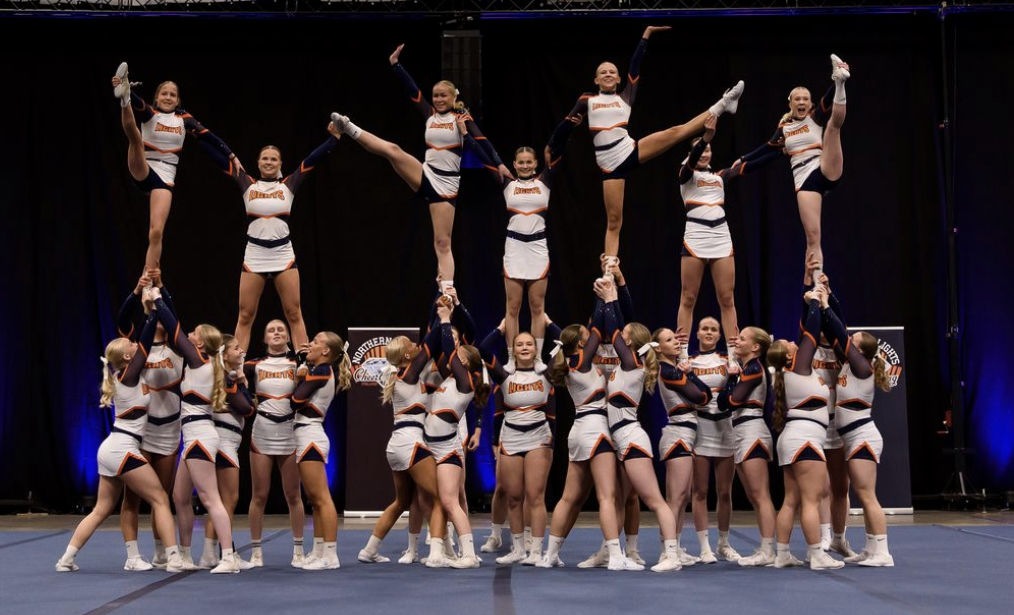
Cheer has come a long way from leading chants in the stands. At a high school football game, cheerleaders still energize the crowd and support their team. At a competitive cheerleading event, the focus shifts to athletic performance. Teams execute synchronized tumbling passes, lift flyers into elevated positions and move through tightly choreographed sequences where a single missed grip can disrupt an entire stunt.
Both forms demand teamwork, physical ability and confidence. Their purposes differ, though. Sideline cheer centers on crowd participation and school spirit, while competitive programs prepare athletes for judged routines built around technical skills, execution and difficulty.
That distinction shapes everything from training schedules and team composition to the skills athletes perform on the competition floor.
From Sideline Cheer to Competitive Cheerleading
Traditional cheerleading grew out of school sporting events, where organized squads used chants, motions and coordinated movements to encourage spectators. Gymnastics, partner stunts and increasingly complex choreography gradually became part of the activity.
Today, cheer encompasses several formats. School squads may support football and basketball teams while also competing during the season. Competitive All Star programs generally train at dedicated gyms, with their schedules built around competitions. Collegiate teams often balance game-day appearances with national championship preparation.
Sideline cheer responds to what happens in the game, using chants and motions to involve spectators. Competitive cheerleading follows a rehearsed routine, with formations, transitions and technical elements arranged to meet specific judging criteria.
Neither format is simply a less demanding version of the other. Engaging a stadium crowd takes communication and presence. Competition places greater pressure on precision, synchronization and the ability to perform difficult skills consistently.
How Cheerleading Competitions Work
At most cheerleading competitions, teams enter divisions based on eligibility requirements, perform within a set time limit and receive scores under the event’s judging system.
Rules differ across school, college, All Star and international competitions. USA Cheer develops safety guidance and rules for several cheer disciplines, while the National Federation of State High School Associations (NFHS) publishes spirit rules used by many school programs. The International Cheer Union (ICU) governs international cheer competition, and individual event producers may apply their own scoring systems within the relevant framework.
Competition formats aren’t identical, either. Some events use a single judged performance. Others feature preliminary rounds followed by finals, with advancement and score calculations determined by the organizer. At certain championships, teams perform on multiple days, making consistency especially important.
A stunt permitted at one competitive level may be restricted at another. Coaches must check the applicable rulebook before selecting skills or finalizing choreography.
Team Divisions and Performance Categories
Divisions help place teams against appropriate competitors. Depending on the organization, eligibility may depend on age, roster size, skill level, school classification or team composition.
All-Star cheer commonly uses skill-based levels that determine which stunts, pyramids and tumbling elements athletes may perform. School competitions may separate teams by enrollment, squad size or competitive category.
Some events include Game Day divisions, which draw more heavily on traditional cheerleading. Performances may feature crowd-leading, band chants, situational cheers and responses to simulated game situations rather than a conventional continuous routine.
Team composition also influences choreography. Smaller cheerleading teams may have fewer stunt groups available for simultaneous formations, while larger squads must coordinate more athletes across the performance surface. Neither arrangement guarantees a scoring advantage; the relevant rubric determines how skills and execution are evaluated.
Before entering a competition, coaches review roster eligibility, division requirements and skill restrictions. These decisions affect both team placement and the routine athletes can legally perform.
Scoring and Judging Criteria
Judges evaluate the difficulty of the skills performed, their execution and the overall quality of the routine. Scoring systems vary, but several technical areas appear regularly:
- Stunt execution, difficulty and synchronization
- Tumbling technique and consistency
- Pyramid construction and transitions
- Jumps, motions and overall performance quality
- Routine composition, creativity and use of formations
Difficulty and execution serve different purposes. Consider two teams performing comparable stunt sequences. One completes every lift with stable body positions and synchronized dismounts. The other reaches the same positions but shows visible balance corrections and uneven timing. Even without a fall, those execution differences may affect the judges’ assessment.
More serious errors can carry specific penalties. Depending on the rules, a stunt fall, illegal skill or boundary violation may trigger a deduction separate from the technical score. Some rubrics also distinguish between minor instability and a complete stunt failure.
High difficulty doesn’t guarantee a strong result. Advanced choreography can lose its advantage when mistakes accumulate, although the balance between difficulty and execution depends on the scoring system.
Building a Competitive Cheer Routine
Coaches design cheer routines around the team’s abilities, competition rules and available performance time. Stunts, tumbling passes and choreography must fit together without placing the most physically demanding elements where athletes are least prepared to execute them.
Routine construction involves careful spacing and workload management. Coaches consider how athletes enter formations, where stunt groups are positioned and how much recovery is possible between demanding sections.
Opening sequences often establish the team’s energy and technical strengths. Later sections can introduce changes in formation, contrasting movement styles or more demanding combinations. The ending needs to feel deliberate rather than simply marking the point where the music stops.
A sequence that succeeds occasionally in practice may be unsuitable for competition. Consistency under full-routine conditions matters when deciding which elements make the final choreography.
Stunts, Pyramids and Tumbling
Cheerleading stunts involve athletes lifting, supporting or balancing a teammate known as the flyer. Bases provide primary support, while a back spot or other designated spotters may assist with stability, control and safety, depending on the stunt configuration.
Several common terms describe stunt positions and movements. A prep generally places the flyer’s feet around the bases’ shoulder level, while an extension raises the supported flyer to an extended-arm position. A cradle is a dismount in which the flyer is caught in a supported, reclined position. Exact technique and legality depend on the stunt and division.
Each position carries technical responsibilities. Bases need coordinated lifting mechanics, stable body positions and secure grips. Flyers must maintain body tension, balance and control throughout the movement. Strength and communication matter to everyone involved.
Pyramids bring elevated athletes together through permitted connections. Their construction depends on division-specific rules governing support, height, transitions and dismounts. A formation that is legal at an advanced level may be prohibited for younger or less experienced teams.
Cheerleading tumbling includes cartwheels, roundoffs, handsprings, aerial skills and twisting elements, with permitted skills determined by the division. Standing tumbling begins without a running approach. Running tumbling uses forward momentum, often starting with a run or hurdle into a roundoff.
A roundoff back handspring is a familiar progression in tumbling training. More advanced athletes may connect additional handsprings or transition into a back tuck or layout where permitted. These combinations require sufficient technique, strength and supervised progression rather than simply greater confidence.
Controlled takeoffs, body alignment and safe landings underpin all these cheerleading skills. Coaches develop the mechanics before introducing more demanding combinations.
Jumps, Dance and Transitions
Jumps test explosive power, flexibility and coordination. Toe touches, pikes and hurdler variations are among the most recognizable cheerleading jumps.
In a toe touch, athletes jump into a wide straddle position while maintaining controlled upper-body alignment. Despite the name, reaching down to touch the toes isn’t the objective. Excessive forward folding, bent legs and unstable landings can reduce the quality of the movement.
A hurdler uses an asymmetrical leg position, with one leg extended and the other bent. Correct arm placement and controlled body positioning help distinguish a technically sound jump from one that merely reaches sufficient height.
Dance sections change the pace of a routine and emphasize musical accents through coordinated movements. Sharp arm motions, clean formations and consistent timing help create a unified performance.
Transitions connect these elements. Athletes need clear paths between formations, especially when several stunt groups share the floor. Poor spacing can cause delays or collisions, while unnecessary movement interrupts the routine’s rhythm.
Effective cheerleading choreography accounts for these details before athletes begin full run-throughs.
The Role of Music and Timing in Cheer Performances
Cheer music provides the rhythmic structure for choreography. Competition mixes frequently combine musical excerpts, percussion, vocal elements and sound effects to mark transitions or highlight major skills.
Most teams rehearse movements in eight-count phrases. Athletes use these counts to coordinate lifts, releases, landings and formation changes, even when the music contains complicated rhythmic patterns.
Synchronization becomes particularly important when multiple groups execute the same stunt. A flyer reaching an extension late or a tumbling pass finishing off-count can make an otherwise coordinated section appear uneven.
Coaches sometimes rehearse without music, calling counts aloud until athletes can complete a section consistently. Music is then reintroduced to test whether the timing holds at performance speed. This approach can expose rushed transitions that aren’t obvious during slower technical practice.
Music requirements also vary by event. Teams must follow applicable licensing, content and performance rules, including any restrictions on recorded vocals or musical accompaniment.
Strength, Flexibility and Conditioning for Cheerleaders
Competitive cheerleading combines explosive movements, strength, mobility and cardiovascular endurance. Athletes may perform tumbling passes, maintain elevated stunt positions and complete fast choreography within a short routine.
Physical demands vary by role. Bases need lower-body strength, shoulder stability and the ability to generate controlled lifting force. Flyers rely on core strength, balance, mobility and muscular control while elevated. Both positions require coordination and whole-body conditioning.
A cheerleading fitness program may include squats, lunges, rows, presses, core stabilization exercises and progressive jumping drills. Coaches should adjust training to an athlete’s age, experience and physical readiness.
For bases, squats and split squats develop lower-body strength used in lifting movements. Rows and appropriately selected overhead exercises support upper-body control. Flyers can benefit from single-leg balance exercises, controlled core holds and mobility drills that reinforce stable body positions.
Landing mechanics deserve dedicated practice. Athletes need to absorb force through coordinated movement at the hips, knees and ankles rather than relying on stiff-legged landings. Low-intensity jumping exercises can establish these patterns before more demanding plyometric work.
Flexibility supports jumps and advanced flyer positions, but passive range of motion alone isn’t enough. Athletes also need strength and stability to control those positions without placing unnecessary stress on their joints.
Conditioning should reflect competition demands. Full-routine practice helps develop endurance, while shorter technical sessions allow athletes to refine demanding skills without excessive fatigue.
Team Coordination and Training Methods
Cheerleading training depends on individual technique and coordinated group execution. A flyer may hold a stable position independently, but a stunt can still fail if the bases lift at different times or use inconsistent grips.
Coaches usually teach skills separately before combining them into longer sequences. Once athletes can perform an element reliably, they practice its entry, execution and exit within the surrounding choreography.
A typical practice may begin with a general warm-up and movement preparation, followed by focused technical work. Stunt groups can rehearse individual positions while tumblers work on skills appropriate to their experience. Later, the team connects those elements into routine sections before reviewing execution and finishing with conditioning or recovery work.
The order matters. Demanding new skills are generally better practiced when athletes are sufficiently fresh, not after repeated exhausting run-throughs. Full-routine rehearsals serve a different purpose: testing timing, transitions and performance consistency.
Training methods commonly include video analysis, eight-count drills, repeated practice of short sections and full routine run-throughs with adequate recovery between attempts.
Video review helps identify uneven formations, delayed transitions, inconsistent landing mechanics and differences in stunt timing. Athletes can compare their movements with the intended choreography rather than relying entirely on how a performance felt.
Communication is essential within stunt groups. Athletes need agreed verbal cues, clearly assigned responsibilities and a shared understanding of when to stop an unsafe attempt.
Safety and Injury Prevention in Cheerleading
Cheer combines elevated stunts, airborne skills and repeated landings. Qualified supervision and appropriate training conditions are essential, particularly when athletes progress to more complex elements.
Falls from stunts and pyramids can cause serious injuries. Tumbling and jumping also place repeated stress on the wrists, ankles, knees and other joints. Poor landing mechanics, excessive training loads and fatigue can increase injury risk.
Cheerleading safety begins with qualified coaches, suitable training surfaces and compliance with the rules for each skill. Athletes should master basic positions, support techniques and controlled dismounts before attempting more difficult progressions.
Spotting arrangements must meet the relevant safety standards. Coaches should also assess whether athletes have the strength, coordination and experience needed for a new skill before introducing it.
The training environment matters. Teams should use surfaces appropriate for their discipline and skill level, keep landing areas clear and avoid attempting advanced elements without the necessary supervision and protective arrangements.
Warm-ups should gradually raise activity levels and include dynamic mobility and movement-specific preparation. Training loads need attention throughout the season, especially when teams increase routine difficulty or competition frequency.
Persistent pain, unusual fatigue and declining coordination warrant attention. Suspected concussions require immediate removal from activity and appropriate medical evaluation before any return to sport.
FAQ
Is cheerleading considered a sport?
Competitive cheerleading involves structured athletic training, technical skills and judged competitions. Formal recognition varies by organization and jurisdiction. The International Cheer Union is recognized by the International Olympic Committee, although cheerleading is not currently an Olympic medal event.
What’s the difference between school cheer and All Star cheer?
School cheer teams typically support school sporting events and may also compete. Competitive All Star cheer focuses on organized competitions, with athletes usually training at dedicated gyms and entering divisions based on age, eligibility and skill requirements.
Do cheerleaders need gymnastics experience?
Gymnastics experience can help with tumbling, body awareness and coordination, but it isn’t required for every cheerleading program. Beginners can learn foundational movements through supervised training before progressing to more advanced skills.
How long is a competitive cheer routine?
Traditional competitive cheer routines often have a maximum duration of two minutes and thirty seconds. Exact limits vary by organization and category, with some All Star, school and international divisions using shorter or otherwise different timing requirements.
How often should cheerleaders train?
Training frequency depends on age, experience, competitive level and the season. Recreational teams may practice once or twice a week, while advanced competitive squads often train more frequently. Sessions should allow enough time for technical development, conditioning and recovery.